
Calculate the required resistor value and power rating for your LED circuit. Make sure to use a resistor with a power rating higher than the calculated value.
The LED Resistor Calculator calculates the resistor value required for LED circuits. Input source voltage, LED voltage, and LED current to determine the recommended resistor value and power rating. This calculator uses Ohm’s Law to provide accurate calculations for safe LED operation.
An LED resistor calculator is a tool that uses Ohm’s Law to determine the proper resistor value for LED circuits. It helps ensure that your LED receives the correct current by calculating the voltage drop across the resistor. This resistor LED calculator is essential for designing LED circuits that are safe and reliable.
For any LED circuit, a current-limiting resistor is critical to prevent burnout. Here’s how our calculator works:
Key Formula
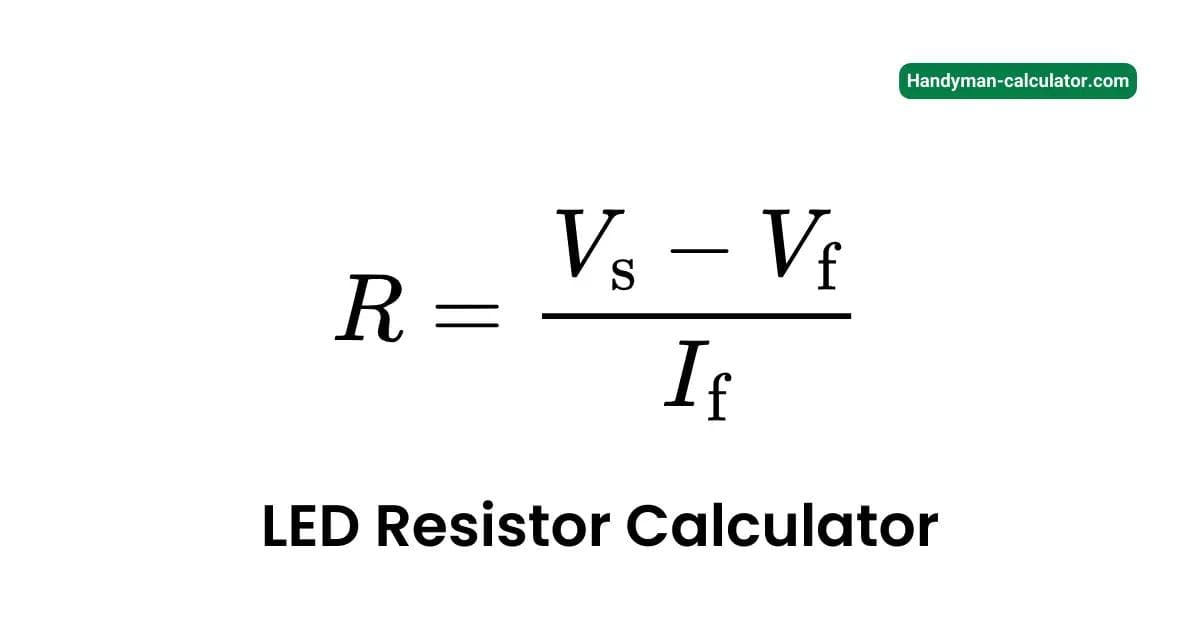
Using Ohm’s Law, the resistor value is calculated as:
The calculator follows these steps:
Where:
Step 1: Voltage Drop
Step 2: Resistor Value
Step 3: Power Dissipation
Result: Use a 150Ω resistor (closest standard value) with a 0.125W (1/8W) rating.
Resistor Value:
Result: Use a 270Ω or 330Ω resistor.
Resistor Value:
Power Dissipation:
Result: A 10kΩ, 5W resistor is required. Always use additional circuitry (e.g., capacitor dropper) for AC/220V applications.
Depending on your circuit configuration, you might need to use our Series LED Resistor Calculator or Parallel LED Resistor Calculator for more specific resistor calculations.
A 1K resistor (1,000Ω) is generally safe for most LEDs and simplifies circuit design. LEDs are less sensitive to current variations than bulbs, so brightness remains stable even with resistor value changes. If the LED seems too bright with a 1K resistor, you can try higher values like 2K ohms or more to reduce the brightness.