
Calculate resistor values for LEDs connected in series. The total LED voltage is the sum of individual LED forward voltages and must be less than the source voltage. All LEDs in series share the same current.
Series LED Resistor Calculator quickly calculates the resistor value needed for LED circuits connected in series. Input your source voltage, LED voltage, LED current, and the number of LEDs to get the exact resistor value, power dissipation, and total voltage drop across the LEDs.
This calculator helps you design safe and efficient LED series circuits.
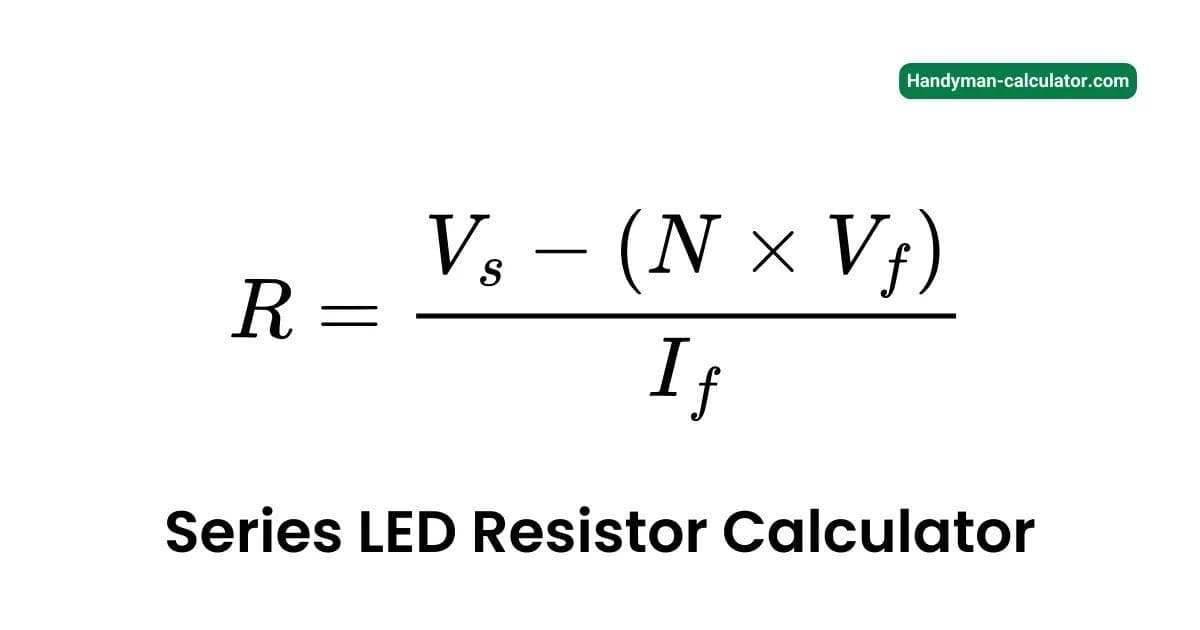
A series LED resistor calculator is used to determine the resistor value needed for multiple LEDs connected in series. In this configuration:
This calculator simplifies the process by using Ohm’s Law and the LED voltage values to find the ideal resistor.
To calculate the correct resistor, input the following values:
In a series LED circuit, the current flowing through the resistor and all LEDs is identical. For example, if your LED current () is 20mA, the same 20mA will pass through the resistor. This simplifies calculations since you only need to determine the resistor value once for the entire chain.
(A ¼-watt resistor is sufficient.)
(A 5W resistor is recommended for safety.)
If your project involves LEDs wired in parallel instead, try our Parallel LED Resistor Calculator for accurate resistor values
Without a resistor, the LEDs may draw excessive current, leading to overheating and damage. A properly calculated resistor limits current and protects the LEDs.
Yes! Unlike parallel circuits, a single resistor can be used for all LEDs in a series circuit because the current remains the same.