
Calculate resistor values for parallel LED configurations. Each LED in parallel requires the same voltage but draws its own current. Make sure to use a resistor with a power rating higher than the calculated value.
Parallel LED Resistor Calculator helps you quickly and accurately calculate resistor for LED in parallel circuits. This tool is designed to determine the correct resistor value for each LED in a parallel configuration, ensuring that every LED receives the proper current.
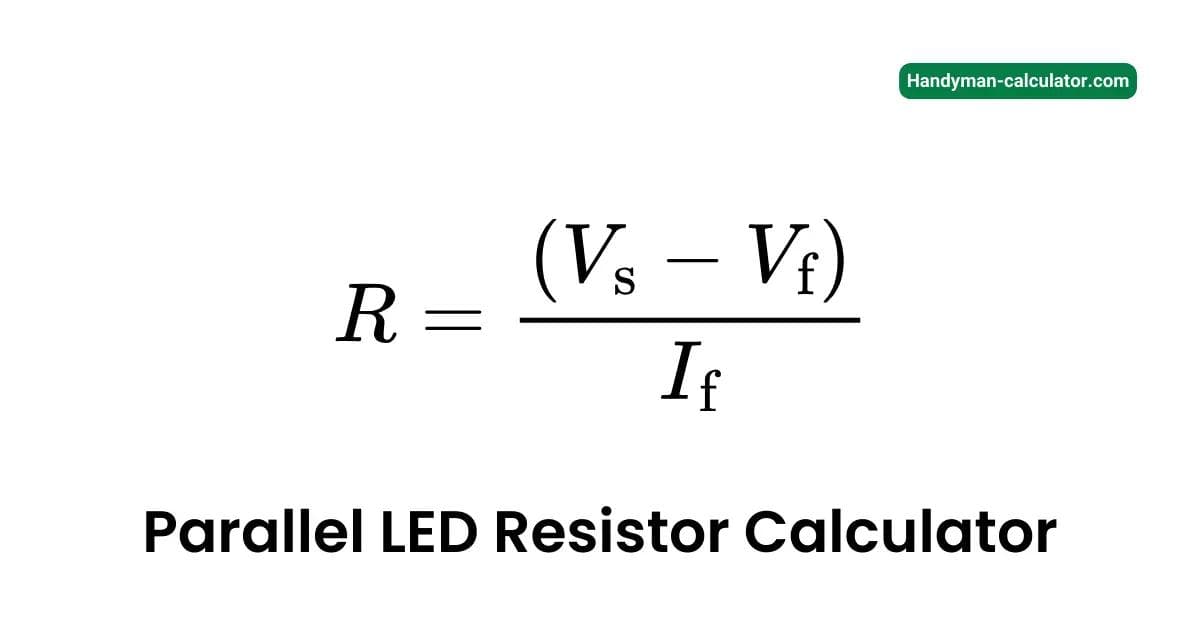
A parallel LED resistor calculator is designed to simplify the process of calculating the resistor value required for each LED when multiple LEDs are connected in parallel. Unlike a series LED resistor calculation, the resistor calculator led parallel takes into account the fact that each LED draws its own current while sharing the same supply voltage.
This calculator ensures that the current through each LED remains within safe operating limits.
When wiring LEDs in parallel, each LED requires its own resistor to prevent uneven current distribution and burnout. Here’s how our calculator works:
Where:
When using our LED Resistor Calculator Parallel, you simply input the following parameters:
The calculator uses these inputs to determine:
Total Current: The sum of the currents for all LEDs in parallel.
Let’s say you want to connect 3 LEDs in parallel to a 12V battery:
Step 1: Calculate Voltage Drop Across Resistor
Step 2: Determine Resistor Value
Step 3: Calculate Power Dissipation
Step 4: Total Current Draw
Result:
Total Circuit Current: 60mA.
It's generally not recommended to use a single resistor for multiple LEDs connected in parallel. LEDs have slight variations in their forward voltage. If you use a single resistor, the current won't be distributed evenly, potentially leading to some LEDs being brighter than others or even causing premature failure.