
Calculate vehicle or machine speed based on engine/motor RPM and wheel diameter. Optional gear ratio can be specified for drive train calculations.
Revolutions Per Minute (RPM) measures the rotational speed of an object, while Miles Per Hour (MPH) measures the linear speed of an object moving across a distance. Converting RPM to MPH is essential for understanding the relationship between rotational and linear motion, particularly in automotive and mechanical applications. The RPM to MPH Calculator simplifies this conversion, enabling precise analysis of vehicle performance and efficiency.
For instance, using the RPM to MPH Calculator helps determine vehicle speed based on engine revolutions, ensuring better performance and efficiency.
Many users are looking for quick answers to common RPM to MPH conversions. To give you a helpful reference, the table below shows the approximate MPH for various RPM values, assuming a common tire diameter of 26 inches.
Keep in mind that the actual MPH will vary depending on the specific diameter of the rotating object. For precise calculations, use our RPM to MPH Calculator.
| RPM | MPH (approx.) |
|---|---|
| 60 | 4.64 |
| 100 | 7.73 |
| 1000 | 77.35 |
| 5000 | 386.74 |
| 6000 | 464.09 |
| 7000 | 541.45 |
| 7800 | 603.33 |
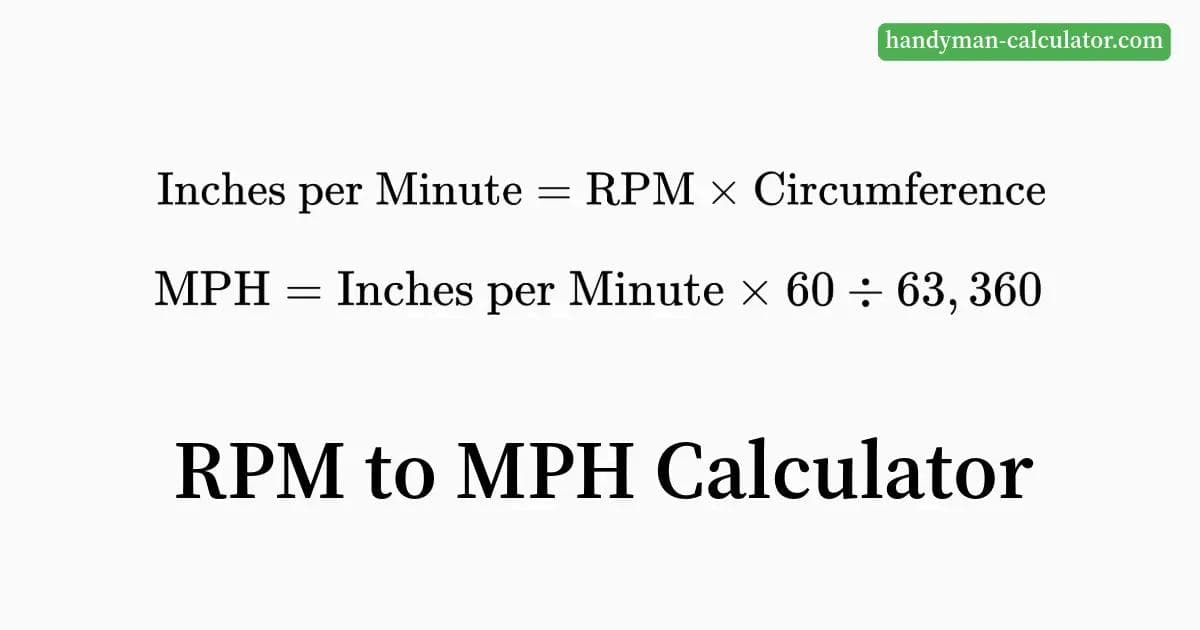
If you want to understand the math behind the calculator, here’s how to calculate MPH from RPM using a step-by-step approach:
Let's walk through an example of calculating the resulting MPH when an object is rotating at 1000 RPM, assuming a tire diameter of 36 inches:
To calculate your speed in MPH:
The calculator will also show you the wheel RPM. For reverse calculations, check out our MPH to RPM Calculator.
At 5000 RPM with a 26-inch tire, you’d travel approximately 386.74 MPH. Use our calculator for custom tire sizes.
A: Gear ratios act as multipliers between engine and wheel speed. For example, in first gear (with typically a 3:1 ratio), the engine turns three times for each wheel rotation, while in higher gears the ratio is much lower for better fuel efficiency.
A: Wheel diameter determines the distance covered in one complete rotation, which is essential for calculating linear speed (MPH) from rotational speed (RPM).
Converting RPM to MPH is essential for understanding vehicle speed, mechanical efficiency, and performance. While the formula might seem complex, our calculator simplifies the process by requiring just three key pieces of information: RPM, wheel diameter, and gear ratio (if applicable).